Work in progress!
Natural Resource Open Access Model
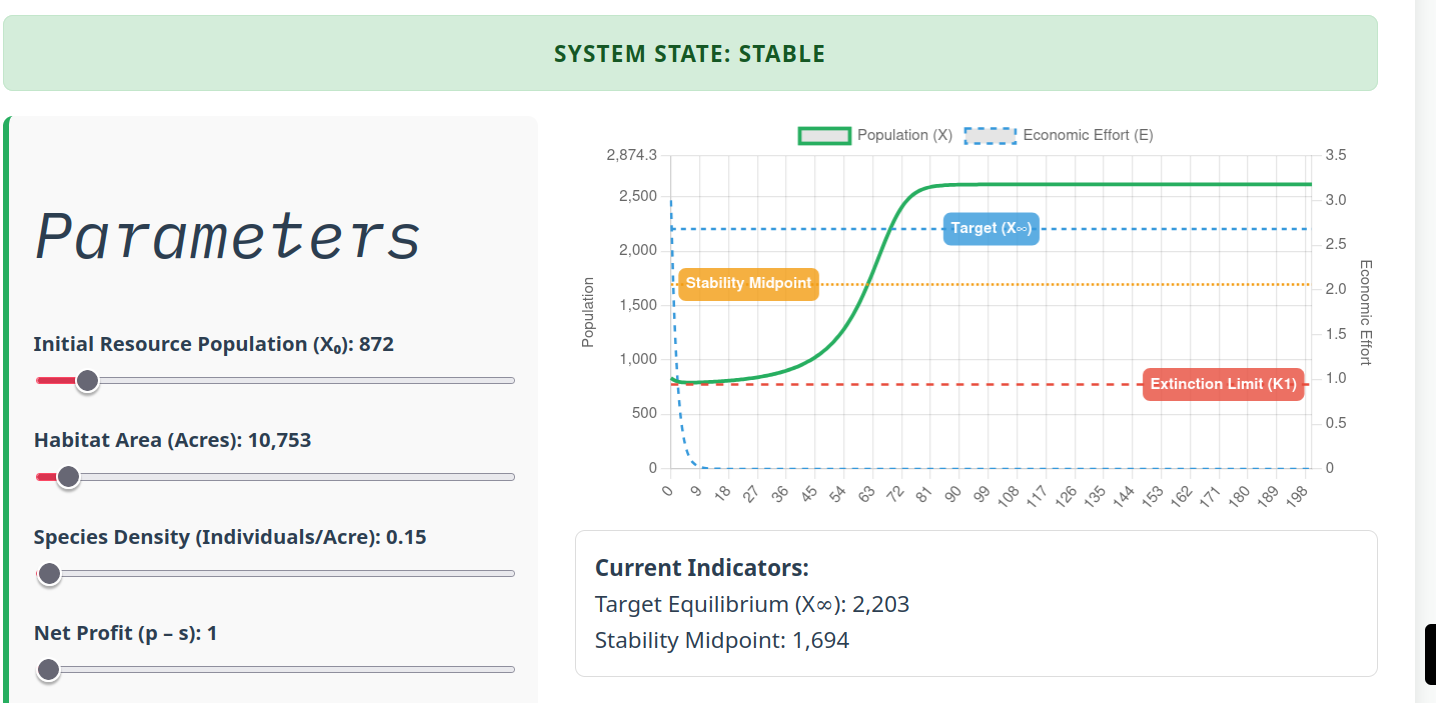
System State: Stable
Parameters
Current Indicators:
Target Equilibrium (X∞): —
Stability Midpoint: —
Target Equilibrium (X∞): —
Stability Midpoint: —
Scientific Context
This model simulates a renewable resource system with critical depensation. The system enters a “Hopf Bifurcation” (wild oscillations) when the economic target falls below the biological midpoint.
$$\frac{dX}{dt} = rX \left(\frac{X}{K_1} – 1\right) \left(1 – \frac{X}{K_2}\right) – qXE$$
$$\frac{dE}{dt} = \alpha[(p – s)qX – c]E$$
The Variables
- X: The renewable resource population.
- E: The level of effort devoted to harvest.
- r: The intrinsic growth rate.
- K₁: The minimum viable population level.
- K₂: The environmental carrying capacity.
- q: The catchability coefficient.
- α: An adjustment coefficient for effort.
- (p−s): The market price net of shipping cost.
- c: The unit cost of effort.
Key Ecological Concepts
- Critical Depensation: If population falls below K₁, it will decline to extinction.
- Open Access Equilibrium (X∞): The population level where the system stabilizes: $$X_{\infty} = \frac{c}{(p – s)q}$$.
- Hopf Bifurcation: As economic conditions change, X∞ can move from stable to unstable, causing wild oscillations that lead to extinction.